
Ethiopian Calendar Explained: 13 Months, Holidays & Orthodox Fasting
13 months · a 12-hour clock that starts at dawn · two liturgical computi on one page.
The Ethiopian clock: sunrise = 12:00
The Ethiopian day begins at dawn, not midnight. When the sun rises over Addis Ababa at approximately 6:00 AM Gregorian, it is 12:00 in Ethiopian time — the start of hour one. Counting continues through the day, so:
- 6:00 AM Gregorian = 12:00 Ethiopian (sunrise)
- 12:00 PM Gregorian = 6:00 Ethiopian (midday)
- 6:00 PM Gregorian = 12:00 Ethiopian (sunset)
- 12:00 AM Gregorian = 6:00 Ethiopian (midnight)
Tip: subtract six hours from the Gregorian clock (mod 12) and you have the Ethiopian time. The Today strip on the converter page does this live — you can watch the shift second by second.
Ethiopian time periods
A day in Ethiopia is split into four named stretches. Each block is six hours long and restarts the 12-hour Ethiopian clock at either “12” (dawn / dusk) or “6” (midday / midnight).
| Period | Amharic | Western (EAT) | Ethiopian clock |
|---|
13 months — and Pagumē
Ethiopia's calendar has twelve months of exactly thirty days each, plus a short thirteenth month called Pagumē with 5 days (6 in leap years, when the Ethiopian year number modulo 4 equals 3). The Ethiopian year runs roughly 8 years behind the Gregorian year, because the two calendars use different dates for the Annunciation.
Here is the full map of Ethiopian months to Gregorian ranges. These ranges shift by one day every four years because of the different leap rules.
| Ethiopian month | Gregorian range |
|---|---|
| Meskerem (New Year) | 11 September – 10 October |
| Tikimt | 11 October – 9 November |
| Hidar | 10 November – 9 December |
| Tahsas | 10 December – 8 January |
| Tir | 9 January – 7 February |
| Yakatit | 8 February – 9 March |
| Maggabit | 10 March – 8 April |
| Miyazya | 9 April – 8 May |
| Ginbot | 9 May – 7 June |
| Sene | 8 June – 7 July |
| Hamle | 8 July – 6 August |
| Nehasa | 7 August – 6 September |
| Pagume | 6 – 10 September (5 days, or 6 in leap years) |
The four Ethiopian seasons
Ethiopia has four named seasons that are tied to the Ethiopian calendar and to agriculture rather than to northern meteorological quarters. Each one spans three Ethiopian months and is anchored to a quarter of the solar year.
Bahre Hasab — the computus of movable feasts
Holidays such as Fasika (Easter), Siklet (Good Friday), and Hosaena (Palm Sunday) are not fixed dates — they move each year. The Ethiopian Orthodox Church computes them with Bahre Hasab, a set of rules derived from the Julian Paschal cycle. Once Fasika is located, every other movable day is simply an offset: Siklet is two days before, Hosaena is seven days before, Great Lent begins fifty-five days before, Pentecost is forty-nine days after.
Between Fasika and Pentecost the weekly Wednesday/Friday fast is suspended — the fifty-day Paskha season. The status chip in the converter reflects this automatically.
The New Year feast in the Church
Proclamation of the year
On Meskerem 1, the Bahre Hasab proclamation for the changing year is announced. During the church celebration, wheat, grapes or raisins, candles, incense, and flower garlands are placed in a golden basket and brought into the qene mahlet as a sign of thanksgiving for the Creator’s blessing.
After the mahlet service, the Bahre Hasab scholar wraps a white shash, wears a kaba, carries a cross, and proclaims the year. He recounts the ancient history of Bahre Hasab and announces the year’s number according to the sun, the moon, and Amete Alem. The entrances of the fasts and the dates of the feasts are also announced within the traditional limits below.
Highest and lowest limits of feasts and fasts
- The Fast of Nineveh begins no earlier than Tir 17 and no later than Yekatit 21.
- Great Lent begins no earlier than Yekatit 1 and no later than Megabit 5.
- Debre Zeit falls no earlier than Yekatit 28 and no later than Miyazya 2.
- Hosaena falls no earlier than Megabit 19 and no later than Miyazya 23.
- Siklet falls no earlier than Megabit 24 and no later than Miyazya 28.
- Fasika falls no earlier than Megabit 26 and no later than Miyazya 30.
- Rikbe Kahinat falls no earlier than Miyazya 20 and no later than Ginbot 24.
- Ascension falls no earlier than Ginbot 5 and no later than Sene 9.
- Pentecost falls no earlier than Ginbot 15 and no later than Sene 19.
- The Apostles’ Fast begins no earlier than Ginbot 16 and no later than Sene 20.
- The Fast of Dihnet begins no earlier than Ginbot 18 and no later than Sene 22.
Weekdays for fasts and feasts
- Fast of Nineveh, Great Lent, and the Apostles’ Fast → Monday
- Debre Zeit, Hosaena, Fasika, and Pentecost → Sunday
- Siklet → Friday
- Rikbe Kahinat and the Fast of Dihnet → Wednesday
- Ascension → Thursday
Wednesday & Friday fasting
The Ethiopian Orthodox Tewahedo Church keeps a fast every Wednesday and Friday throughout the year, from midnight until about 3:00 PM local time. No meat, dairy, eggs, or animal products are eaten on these days.
Why these two days?
- Wednesday — remembers the day the Jewish council (Sanhedrin) conspired to arrest Jesus and hand him over to death.
- Friday — remembers the Crucifixion of Jesus — the fast is kept in sorrow and in preparation for the Resurrection.
When the Wed/Fri fast is set aside
There are only a few exceptions where Wednesday and Friday fasting is not kept:
- The 50 days after Fasika (Paskha) From Easter Sunday through Pentecost, the whole 50-day season is a celebration of the Resurrection, and all weekly fasting is suspended.
- Genna and Timkat falling on a Wed/Fri If Genna (Ethiopian Christmas, Tahsas 29) or Timkat (Epiphany, Tir 11) lands on a Wednesday or Friday, the fast is broken so the feast can be celebrated.
- Other major feasts Meskel and the major Marian feasts, when they coincide with a Wed/Fri, are also treated as feast days rather than fast days.
The Today strip and the converter's Fasting row follow these rules automatically — click any calendar cell to see why a specific day is a fast or a feast.
Holidays on this site
- Orthodox: Genna (Ethiopian Christmas), Timkat (Epiphany), Fasika & Siklet, Meskel, plus the major fasts (Nineveh, Great Lent, Apostles’, Advent, Filseta).
- National: Enkutatash (New Year), Adwa Victory Day, Labor Day, Patriots’ Victory Day.
- Islamic: Eid al-Fitr, Eid al-Adha (Arefa), and Mawlid — using Umm al-Qura approximations; actual observance may shift ±1 day by moon sighting.
Closed days (banks and offices shut) are marked in red on the calendar and collected in a strip at the top of the printable page.
Overview about Ethiopia
Major Ethiopian holidays and public days
Ethiopia’s holiday calendar combines Orthodox Christian feasts, national civic history, and Islamic celebrations. Fixed holidays follow Ethiopian months such as Meskerem, Tahsas, Tir, Yakatit, Megabit, Miyazya, Ginbot, and Nehasa; movable Orthodox feasts follow Bahre Hasab; Islamic dates follow the lunar calendar and may shift by local moon sighting.
Meskerem 1 · September 11/12
Enkutatash — Ethiopian New Year
The Ethiopian New Year is known by several names: Ras Awde Amet, Enkutatash, and Kidus Yohannes. Each name carries its own meaning in Ethiopian tradition.
Ras Awde Amet
Awde Amet describes the cycle of a year: the span that begins on one day and returns to its starting point the next year. A year can be counted from any date, but the regular Ethiopian annual cycle begins on Meskerem 1, which is why the day is called Ras Awde Amet — the head or beginning of the yearly cycle.
The year is grounded in 364 days, or 52 weeks. The extra accumulated time becomes the 365th day, a day that joins one cycle to the next. Every four years an additional 366th day, known as Yelete Segr, is added. The day that follows these closing days opens the new year and is honored as the beginning and meeting point of the annual cycle.
Enkutatash
According to one tradition, the name is tied to Noah. After the flood receded and Noah offered sacrifice, God promised that winter and summer, cold and heat, seedtime and harvest, day and night would continue in their seasons. The rainbow became the sign of that covenant.
When the first post-flood rainy season ended and the sun appeared at the start of Meskerem, the earth was green and bright with flowers. Noah and his family understood God’s mercy and celebrated by offering flowers and gifts. From then on, people exchanged flowers and blessings, saying Enkutatash as a joyful New Year greeting.
Another explanation connects the word to Ham, Noah’s son. When the continents were divided among Noah’s children, Africa fell to Ham. Tradition says he first stepped into Ethiopia during Meskerem, when the land was covered in Adey Abeba flowers. Delighted by the beauty of the land and his allotted inheritance, he said “Enku eta wetalgn” — a precious lot has come to me — and the holiday’s name was preserved from that saying.
Kidus Yohannes
The holiday is also called Kidus Yohannes. One explanation is that John the Baptist was imprisoned beginning on Pagume 1, condemned on Meskerem 1 by King Herod, and martyred on Meskerem 2. Because St. John stands as the bridge between the Old Testament and the Gospel, and New Year stands between the departing and arriving years, Ethiopian scholars established his commemoration around Meskerem 1; the day is therefore also known by his name.


Meskerem 17 · September 27
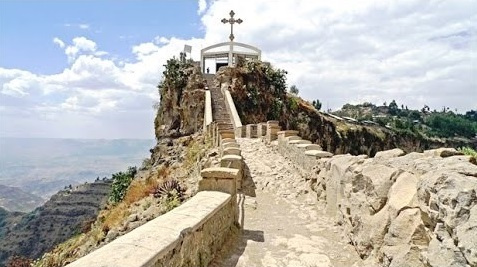
Meskel — Finding of the True Cross


Tahsas 29 · January 7/8
Genna — Ethiopian Christmas


Tir 10 · January 18
Ketera — Timkat Eve


Tir 11 · January 19
Timkat — Ethiopian Epiphany


Yakatit 23 · March 1
Adwa Victory Day


Lunar date · moon sighting
Eid al-Fitr in Ethiopia
Eid al-Fitr (ዒድ አል ፈጥር) marks the end of Ramadan. Ethiopian Muslims gather for dawn prayer, give Zakat al-Fitr before the prayer, visit relatives, share meals, and celebrate in communities such as Harar and Dire Dawa.
Sunday before Fasika
Hosaena — Ethiopian Palm Sunday


Two days before Fasika
Siklet — Ethiopian Good Friday


Bahre Hasab movable feast
Fasika — Ethiopian Easter


Ginbot 1 · May 9
Lideta leMaryam — Birthday of the Virgin Mary
Why We Celebrate Outside
According to the sacred tradition of the Ethiopian Orthodox Tewahedo Church, the Virgin Mary’s mother, Saint Hanna, had to flee from rulers who sought to harm her holy child. She gave birth to Mary on Mount Lebanon, out in the wilderness and away from the comfort of a home. To honor this, Ethiopians step outside into their yards or green spaces to celebrate. Gathering outdoors under the open sky reminds us of the humble, outdoor birthplace of our Holy Mother.
The Sacred Meaning Behind Our Traditional Foods
Because Saint Hanna was hiding on a mountain, she did not have access to an ordinary kitchen. To remember her journey and reliance on simple sustenance, we prepare two specific traditional foods:
- ንፍሮ (Nfro) — A wholesome dish of boiled grains and legumes (wheat, chickpeas, or beans) that represents simple, basic food cooked quickly with water.
- አነባብሮ (Anebabero) — Layered injera spread with spiced butter and berbere, mirroring the quick, stacked bread prepared during times of travel and wilderness living.
Sharing Nfro, Anebabero, popcorn, and traditional coffee outdoors with family and neighbors is a beautiful, centuries-old tradition. It keeps the profound faith, humility, and history of the Ethiopian Orthodox Church alive today.


Miyazya 23 · May 1
International Labor Day in Ethiopia
International Labor Day recognizes workers’ contributions and labor rights. Offices and banks close, while rallies and speeches highlight employment law, workplace safety, wages, and the role of labor in Ethiopia’s economy.
Megabit 23 · April 1
Patriots’ Victory Day


Dhu al-Hijjah 10 · lunar date
Eid al-Adha (Arefa) in Ethiopia
Eid al-Adha (ዒድ አል አድሐ), known locally as Arefa, commemorates Prophet Ibrahim’s obedience and coincides with Hajj. Families share Qurbani meat with relatives, friends, and the poor after communal morning prayer.
Rabi' al-Awwal 12 · lunar date
Mawlid in Ethiopia
Mawlid (ሞዓሊድ) celebrates the Prophet Muhammad’s birthday. In Harar, Qasida poems are recited through the night, while communities elsewhere hold religious lectures, communal meals, and charitable food distribution.